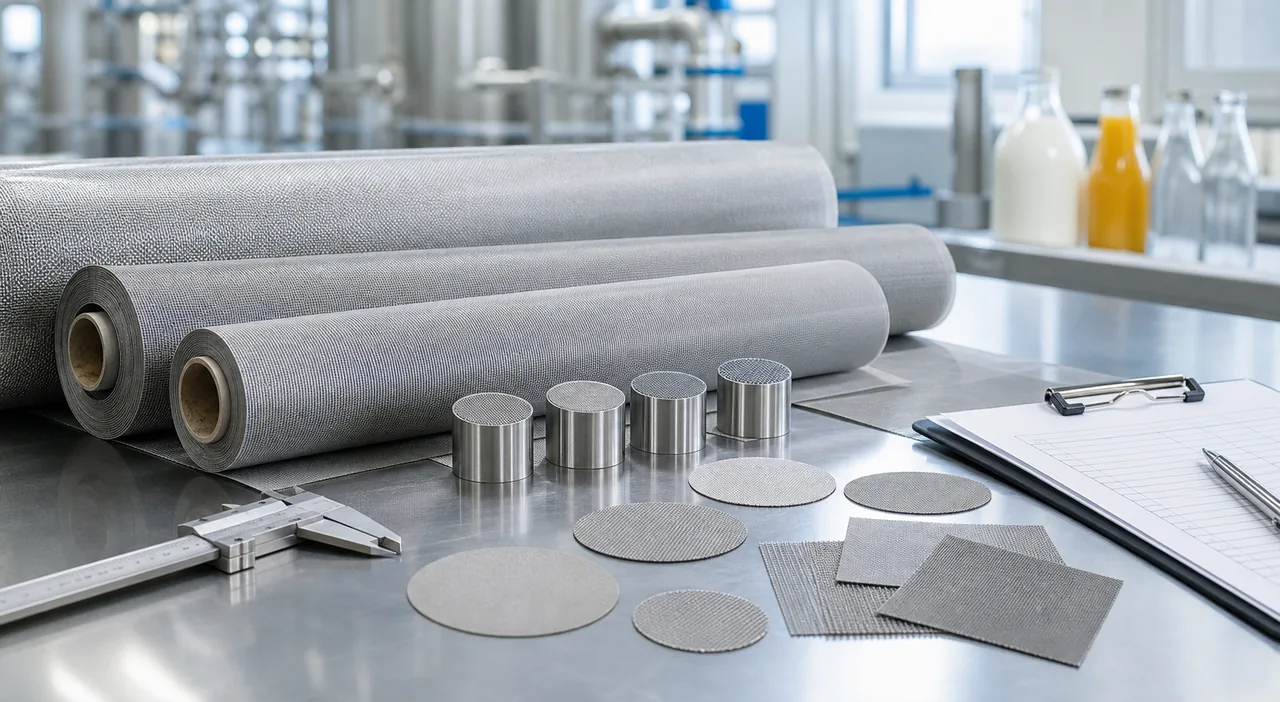
Food and beverage buyers usually search for stainless steel filter mesh when an existing filter screen clogs too quickly, loses shape during cleaning, or cannot meet the required particle retention. A useful RFQ should connect the hygiene requirement with the physical mesh specification.
ANPING MAOYE supplies 304 and 316L stainless steel woven mesh for liquid filtration, powder screening, beverage clarification and custom filter parts. The goal is not only to sell a roll of mesh, but to help the buyer choose a mesh that can be inspected, cleaned and reordered consistently.
Core Specification Checklist
| Buyer decision | Recommended detail to confirm |
| Material grade | 304 for general food contact; 316L for acidic, salty or frequent chemical cleaning environments. |
| Opening size | Use mesh count, aperture in mm, or micron rating. If only one value is known, send the working particle size. |
| Format | Roll, sheet, laser-cut disc, welded panel, tube or custom filter assembly. |
| Quality control | Ask for aperture check, surface inspection, flatness check and packing photos before shipment. |
Why Mesh Consistency Matters
Food processing lines often run with repeated cleaning and batch cycles. If the mesh opening varies too much, a buyer may see unstable flow rate, visible residue, or premature replacement. Stable wire diameter and controlled weave tension make the mesh easier to validate inside a purchasing system.
- Use 316L when the medium contains salt, organic acid, alcohol or aggressive cleaning chemicals.
- Confirm whether the mesh must be cut into discs, welded into cylinders or supplied as full rolls.
- Request packing that protects edges and prevents deformation during ocean or air shipment.
RFQ Information That Reduces Back-And-Forth
A clear inquiry should include material grade, target micron rating, roll width or part drawing, annual estimated usage and whether a sample is needed. This helps the factory quote the right material and avoid unsuitable stock substitutions.
Buyer FAQ
Is 304 or 316L better for food and beverage filter mesh?
304 is suitable for many dry or neutral food applications, while 316L is preferred for acidic, salty or higher-corrosion liquid filtration. Buyers should confirm liquid chemistry, cleaning method and service temperature before ordering.
What details help a factory quote food grade filter mesh faster?
Provide material grade, mesh count or micron rating, wire diameter, roll width, cut size, quantity, edge treatment and the filter housing or production process where the mesh will be used.
Can ANPING MAOYE provide samples before bulk food filtration orders?
Qualified B2B buyers can request small samples to compare aperture, surface finish and stiffness before confirming bulk roll, disc or custom component orders.