
When you are designing or replacing an industrial filtration system, the shape of the filter element is just as important as the mesh count or material grade. A disc that works perfectly in a plate-and-frame filter press will fail in a pipeline basket strainer. A cylindrical mesh element that fits a hydraulic filter housing will be useless inside a polymer extruder head.
At ANPING MAOYE, we manufacture stainless steel mesh filter elements in 10+ standard shapes, from single-layer discs to multi-layer pleated cartridges. We supply custom wire mesh filter OEM orders to industrial clients in water treatment, oil & gas, chemical processing, food & beverage, pharmaceutical, and polymer extrusion industries. If you know your filter housing or process geometry, we can produce the exact shape you need.
This guide breaks down the 10 most common stainless steel mesh filter shapes, what each is best for, and how to specify a custom filter element that fits your equipment exactly.
10 Stainless Steel Mesh Filter Shapes Every Engineer Should Know
1. Wire Mesh Filter Disc
Also called: round filter disc, multi-layer filter disc, sintered filter disc, mesh screen disc
The wire mesh filter disc is the most common filter shape. It is a flat, circular piece of woven wire mesh, often laminated with multiple layers for graded filtration or supported by a perforated backing plate for structural strength.
Best for:
- Inline disc filters (sandwich-style between flanges)
- Plate-and-frame filter presses
- Extruder screen packs (stacked discs)
- Suction or discharge filters on pumps and compressors
- Laboratory and analytical filtration
Common specifications:
| Parameter | Standard Range | Custom Range |
|---|---|---|
| Diameter | 20 mm – 500 mm | 10 mm – 1,000 mm |
| Layers | 1 – 5 layers | 2 – 7 layers (sintered) |
| Material | 304 / 316L | 316L / 904L / 2205 Duplex |
| Mesh count | 20 – 400 mesh | 4 – 635 mesh |
| Edge | Raw cut, spot-welded rim, or rimless | Welded rim with flange holes |
| Backing | None, or perforated metal plate | Spot-welded support ring |
When to choose a disc: Your filter housing has a flat sealing face, or your process requires a stackable element that can be replaced layer by layer. If you need high pressure rating, choose a multi-layer sintered filter disc instead of a single-layer woven disc.
For a deeper look at multi-layer and sintered disc construction, see our sintered mesh vs woven mesh guide.
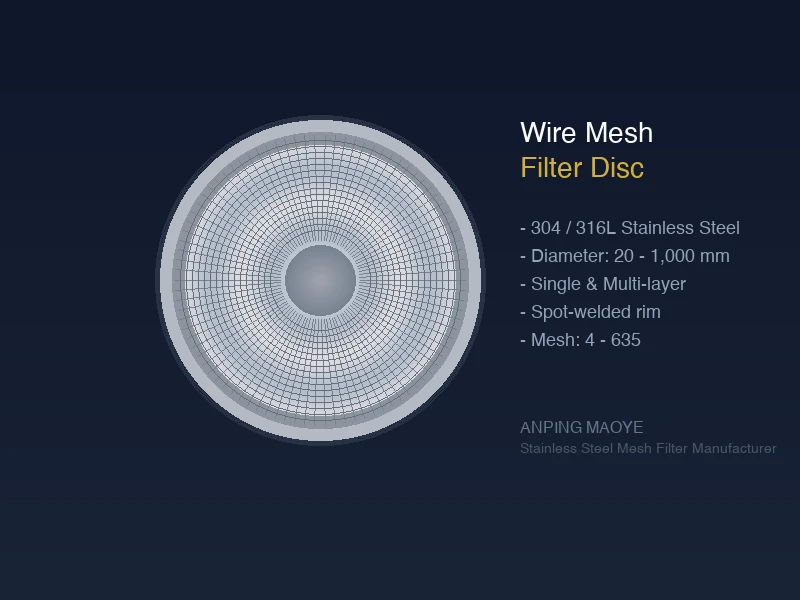 Figure: 304/316L stainless steel wire mesh filter discs — single-layer and multi-layer sintered variants. Diameter range: 20–1,000 mm. Spot-welded rim, perforated backing, mesh count: 4–635.
2. Wire Mesh Filter Cylinder
Also called: cylindrical mesh filter, wire mesh filter tube, mesh filter element, filter sleeve
The wire mesh filter cylinder is a hollow tube formed from woven mesh and sealed along a longitudinal seam. It is the standard shape for most in-line filter housings where fluid flows from outside to inside (or inside to outside) through the cylindrical wall.
Best for:
- Hydraulic and lubrication oil filters
- Fuel and diesel filtration systems
- Process fluid filters in chemical plants
- Water and wastewater treatment cartridge housings
- Air and gas intake filters
Common specifications:
| Parameter | Standard Range | Custom Range |
|---|---|---|
| Diameter | 25 mm – 300 mm | 10 mm – 500 mm |
| Length | 100 mm – 1,000 mm | 50 mm – 2,000 mm |
| Seam | Longitudinal seam weld | Seamless spiral winding |
| End caps | Plain, welded rim, or threaded adapter | Custom flange or bayonet fitting |
| Support | Inner support tube (perforated metal) | Outer support cage |
When to choose a cylinder: Your filter housing is a cylindrical cartridge housing, or your fluid path is radial (perpendicular to the cylinder axis). Cylinders offer the highest surface area-to-volume ratio for single-pass filtration. If you need pleated construction for even higher surface area, see the pleated filter section below.
For detailed specifications on filter cylinders and cartridge construction, see our stainless steel filter cylinders and cartridges guide.
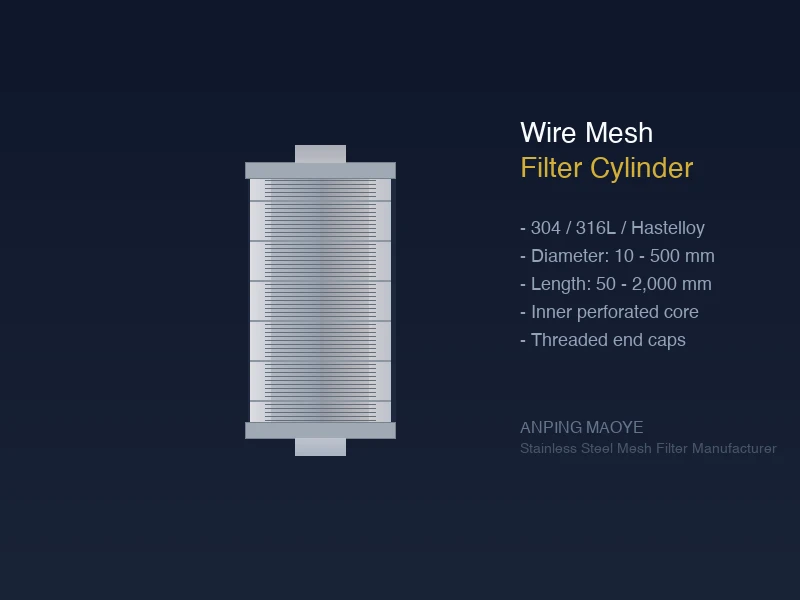 Figure: 316L stainless steel mesh filter cylinder — outer mesh cylinder with inner perforated support core and threaded end caps. Diameter: 10–500 mm, Length: 50–2,000 mm. Standard for hydraulic oil and fuel filtration systems.
3. Wire Mesh Filter Tube / Filter Pipe
Also called: filter tube, mesh pipe, screen pipe, perforated tube with mesh lining
The wire mesh filter tube is similar to a cylinder but typically has a thicker wall and is designed to withstand axial flow (flow parallel to the tube axis). It is often used as a perforated metal tube lined with wire mesh, combining the structural strength of the metal tube with the filtration precision of the mesh.
Best for:
- Well screens and sand control in oil & gas
- Suction strainers on pump inlets
- Catalyst bed support screens in chemical reactors
- Large-diameter process filters
- Backwashable pre-filters in water treatment
Common specifications:
| Parameter | Standard Range | Custom Range |
|---|---|---|
| Diameter | 50 mm – 500 mm | 25 mm – 1,000 mm |
| Length | 200 mm – 2,000 mm | 100 mm – 3,000 mm |
| Wall thickness | 2 mm – 10 mm | 1 mm – 20 mm |
| Base tube | Perforated metal (carbon steel or SS) | Solid SS tube with drilled holes |
| Mesh lining | Single or double layer | Multi-layer with sintered bonding |
When to choose a tube: Your process involves high flow rates, axial fluid direction, or the filter element must act as both a structural support and a filtration barrier. Tubes are common in oil & gas well completions and large industrial strainers.
4. Wire Mesh Filter Basket / Strainer
Also called: filter basket, basket strainer, mesh basket, temporary strainer, cone strainer
The wire mesh filter basket is a cup-shaped or cone-shaped element that sits inside a basket strainer housing. It is the standard shape for coarse to medium pre-filtration in pipelines, where the goal is to protect downstream pumps, valves, and meters from debris.
Best for:
- Pipeline basket strainers (water, oil, chemicals)
- Temporary start-up strainers (cone strainers)
- Tank outlet screens
- Pump suction strainers
- Cooling water intake screens
Common specifications:
| Parameter | Standard Range | Custom Range |
|---|---|---|
| Diameter (top) | 50 mm – 500 mm | 25 mm – 1,000 mm |
| Height / depth | 100 mm – 500 mm | 50 mm – 1,000 mm |
| Shape | Cylindrical basket or conical basket | Custom basket with flange lip |
| Mesh | 10 – 100 mesh (coarse to medium) | 200 mesh for fine basket strainers |
| Reinforcement | Spot-welded support ribs | Full seam-welded frame |
| End | Open bottom or closed bottom | Flat bottom with drain port |
When to choose a basket: Your system requires a removable, cleanable pre-filter that captures large debris before it reaches fine filters. Basket strainers are designed for frequent cleaning and replacement. The cone-shaped temporary strainer is used during start-up and commissioning, then removed.
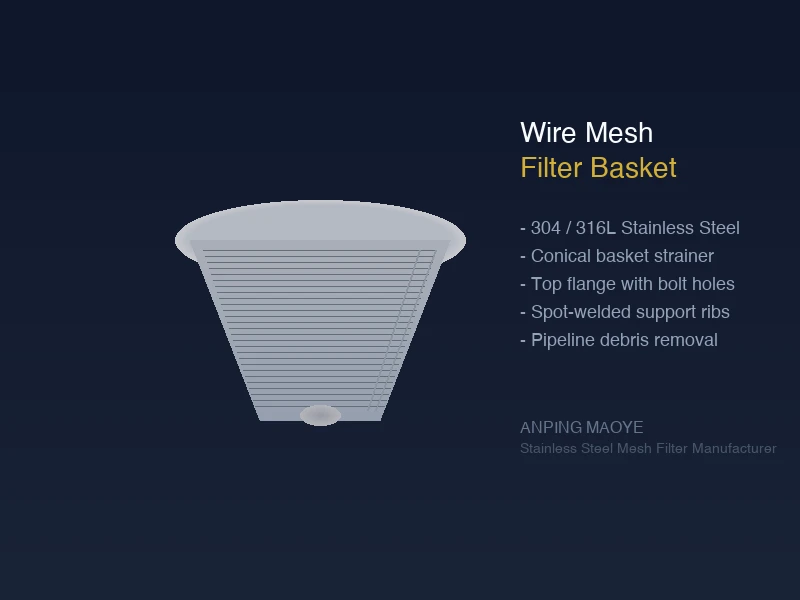 Figure: 316L stainless steel mesh filter basket strainer — conical basket form with top flange rim and spot-welded support ribs. Used in pipeline strainers for coarse debris removal and pump protection.
5. Wire Mesh Filter Screen / Filter Sheet
Also called: filter screen, mesh screen, filter sheet, wire mesh screen, vibrating screen
The wire mesh filter screen is a flat, rectangular sheet of woven mesh, often with a welded or clamped frame. Unlike a disc, which is typically round, a screen can be any rectangular or custom shape. It is used in applications where the filter element is a flat panel rather than a cylindrical or disc form.
Best for:
- Vibrating sieve decks and shakers (mining, quarrying, aggregates)
- Architectural and decorative screens (not filtration, but common use)
- Fluidized bed support screens
- Drying and dewatering screens
- Test sieves and laboratory screens
Common specifications:
| Parameter | Standard Range | Custom Range |
|---|---|---|
| Width | 500 mm – 1,500 mm | 100 mm – 3,000 mm |
| Length | 500 mm – 2,000 mm | 200 mm – 4,000 mm |
| Frame | Spot-welded SS frame or clamped edge | Bolt-on frame for vibrating decks |
| Mesh | 4 – 325 mesh | 635 mesh for test sieves |
| Tension | Pre-tensioned for vibrating screens | Loose mesh for static screens |
When to choose a screen: Your application is a flat, panel-based filtration or separation process, such as a vibrating screen deck, a fluidized bed, or a test sieve. For most inline filtration systems, a disc or cylinder is more appropriate.
6. Wire Mesh Filter Cartridge / Pleated Wire Mesh Filter
Also called: pleated wire mesh filter, pleated filter cartridge, wire mesh filter element, high-surface-area filter
The pleated wire mesh filter cartridge takes a cylindrical mesh element and pleats (folds) the mesh to multiply the filtration surface area within the same housing volume. A standard cylindrical cartridge might have 0.1 m² of surface area; a pleated cartridge of the same dimensions can have 0.5–1.5 m².
Best for:
- High-flow hydraulic and lube oil systems
- Fine chemical and pharmaceutical filtration
- Fuel and aviation filtration
- Food & beverage membrane pre-filtration
- Air and gas compressed-air filtration
Common specifications:
| Parameter | Standard Range | Custom Range |
|---|---|---|
| Diameter | 25 mm – 150 mm | 15 mm – 300 mm |
| Length | 125 mm – 1,000 mm | 50 mm – 1,500 mm |
| Pleat count | 20 – 100 pleats | 10 – 200 pleats |
| End caps | DOE (double open end), SOE (single open end) | Custom thread or flange fitting |
| Support | Inner perforated core + outer cage | Sintered mesh pleats for high pressure |
| Material | 304 / 316L | 316L / Hastelloy / Inconel |
When to choose a pleated cartridge: Your system has high flow rates and limited housing volume, and you need to maximize filter life between replacements. Pleated filters are the standard for hydraulic and compressed-air systems. They cost more than plain cylinders but last significantly longer.
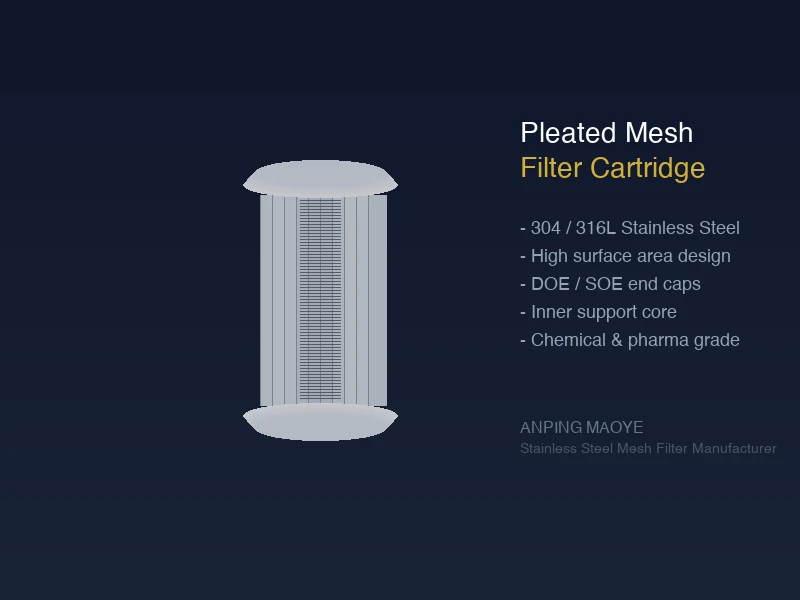 Figure: Pleated wire mesh filter cartridge cross-section — 20–200 pleats multiply filtration surface area to 0.5–1.5 m² within a compact housing. Standard for hydraulic oil and compressed-air systems.
7. Sintered Filter Disc / Multi-Layer Filter Disc
Also called: sintered mesh filter, multi-layer sintered disc, bonded mesh disc, porous metal disc
The sintered filter disc is made by stacking multiple layers of wire mesh with different mesh counts and bonding them under heat and pressure in a vacuum furnace. The result is a rigid, self-supporting disc with a graded pore structure that captures particles progressively across the layers.
Best for:
- High-pressure hydraulic systems (up to 500 bar)
- Polymer melt filtration (extrusion, injection molding)
- Chemical reactor internals and catalyst support
- Gas spargers and bubblers in bioreactors
- Pneumatic and vacuum filters
Common specifications:
| Parameter | Standard Range | Custom Range |
|---|---|---|
| Diameter | 20 mm – 300 mm | 10 mm – 500 mm |
| Layers | 3 – 5 layers | 2 – 7 layers |
| Layer gradation | Coarse (support) → Fine (filtration) | Reverse gradation for back-flushing |
| Thickness | 1.5 mm – 3.0 mm | 0.5 mm – 5.0 mm |
| Porosity | 30% – 50% | 20% – 60% (custom sintered) |
| Burst pressure | 100 – 300 bar | 500 bar with reinforced backing |
When to choose a sintered disc: Your application requires high pressure, high temperature, or the ability to withstand reverse flow (back-flushing). Sintered discs are the only choice for polymer extrusion and high-pressure hydraulic systems where a single-layer woven mesh would deform or fail.
For a full comparison of sintered vs woven mesh construction, see our sintered mesh vs woven mesh guide.
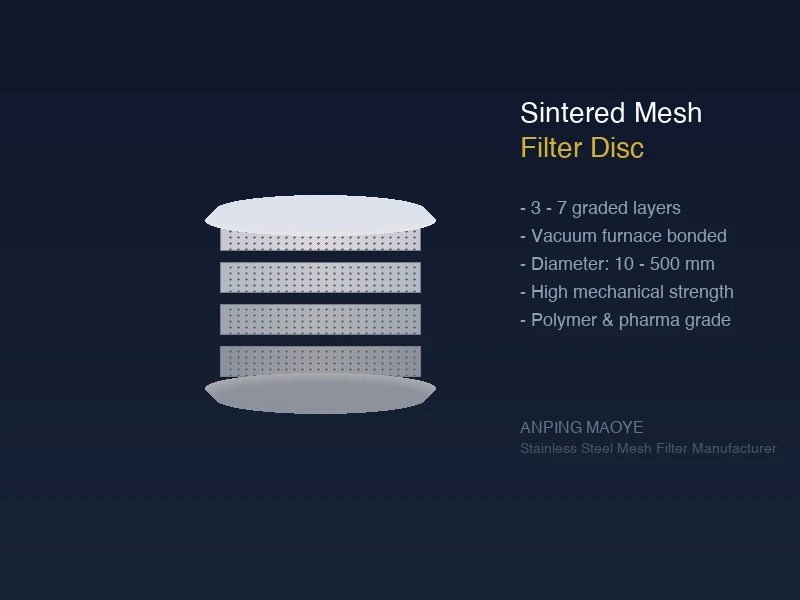 Figure: Sintered multi-layer filter disc cross-section — 3–7 layers bonded under heat and pressure in a vacuum furnace. Graded pore structure (coarse support → fine filtration) delivers burst pressures up to 500 bar. Standard for polymer extrusion and high-pressure hydraulic systems.
8. Perforated Metal Filter / Perforated Filter Plate
Also called: perforated filter plate, hole plate filter, drilled plate strainer, pre-filter plate
The perforated metal filter is not a woven mesh product at all — it is a solid metal plate with precision-drilled or punched holes of a uniform diameter. It is used as a coarse pre-filter, a structural support for woven mesh, or a flow-distribution plate.
Best for:
- Coarse debris screening (pre-filter before wire mesh)
- Structural support for thin woven mesh discs
- Flow distribution and mixing plates
- Catalyst bed support grids
- Dewatering and drainage plates
Common specifications:
| Parameter | Standard Range | Custom Range |
|---|---|---|
| Hole diameter | 0.5 mm – 10 mm | 0.3 mm – 50 mm |
| Hole pattern | Round, square, staggered | Slotted, hexagonal, custom pattern |
| Open area | 20% – 40% | 10% – 60% |
| Plate thickness | 1.0 mm – 5.0 mm | 0.5 mm – 10.0 mm |
| Material | 304 / 316L / Carbon steel | 316L / 904L / Titanium |
When to choose perforated metal: Your primary need is structural support, coarse debris removal, or flow distribution. Perforated metal is rarely used as the sole filtration element for fine particles, but it is essential as a backing plate for wire mesh discs and as a pre-filter in basket strainers.
9. Extruder Screen Pack / Polymer Filter Screen
Also called: extruder screen pack, screen changer pack, polymer filter pack, breaker plate screen
The extruder screen pack is a stacked assembly of multiple wire mesh discs and perforated metal plates used in polymer extrusion lines (plastic, rubber, fiber). The stack sits on a breaker plate inside the extruder head and filters molten polymer before it reaches the die.
Best for:
- Plastic extrusion (PP, PE, PVC, PET, nylon)
- Rubber and tire manufacturing
- Synthetic fiber spinning
- Film and sheet extrusion
- Compounding and masterbatch production
Common specifications:
| Parameter | Standard Range | Custom Range |
|---|---|---|
| Disc diameter | 50 mm – 300 mm | 20 mm – 500 mm |
| Stack composition | 3 – 7 discs (coarse → fine → coarse) | 2 – 10 discs with sintered layers |
| Mesh range | 20 – 400 mesh | 4 – 635 mesh |
| Breaker plate | Perforated SS plate with 3–6 mm holes | Custom hole pattern for your die |
| Material | 304 / 316L | 316L / 904L for high-temperature polymers |
When to choose an extruder screen pack: Your process is polymer extrusion and you need to remove contaminants (metal, gels, degraded polymer) from the melt stream before it reaches the die. Screen packs are designed for high-temperature, high-pressure environments and are replaced at regular intervals during production.
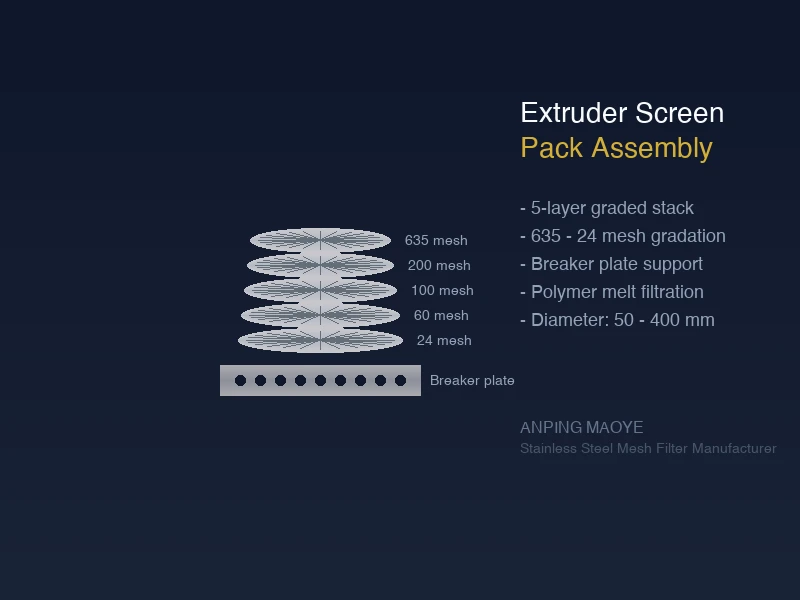 Figure: Extruder screen pack assembly — 3–10 stacked mesh discs (coarse → fine → coarse) sit on a perforated breaker plate inside the extruder head. 316L/904L stainless steel withstands high-temperature polymer melt (PP, PE, PVC, PET, nylon).
10. Knitted Wire Mesh Filter / Demister Pad
Also called: knitted wire mesh filter, demister pad, mist eliminator, coalescer pad, wire mesh scrubber
The knitted wire mesh filter is made from interlocking loops of wire (like a metal sweater) rather than a woven grid. It is highly compressible and has a high void fraction, making it ideal for gas-liquid separation, mist elimination, and coalescing applications.
Best for:
- Demister pads in distillation columns and scrubbers
- Mist eliminators in chemical processing
- Coalescing filters for oil-water separation
- Silencers and mufflers in pneumatic systems
- Cushioning and vibration dampening in industrial equipment
Common specifications:
| Parameter | Standard Range | Custom Range |
|---|---|---|
| Wire diameter | 0.10 mm – 0.30 mm | 0.05 mm – 0.50 mm |
| Density (kg/m³) | 100 – 250 kg/m³ | 50 – 400 kg/m³ |
| Material | 304 / 316L | 316L / Monel / Nickel / Titanium |
| Shape | Flat pad or cylindrical roll | Custom-shaped pad with support grid |
| Support | SS wire grid top and bottom | Custom support frame for vessel installation |
When to choose a knitted mesh filter: Your application is gas-liquid separation (mist, droplets, foam) rather than solid-particle filtration. Knitted mesh filters work by capturing droplets on the wire surface and allowing them to coalesce and drain. They are not suitable for filtering solid particles from liquid streams.
How to Choose the Right Filter Shape: A Decision Matrix
If you are not sure which filter shape to specify, use this decision matrix based on your process parameters:
| If your system is… | Choose this shape | Typical material | Typical mesh |
|---|---|---|---|
| Inline pipeline filter (disc between flanges) | Filter disc | 316L | 40–200 mesh |
| Hydraulic oil filter cartridge | Cylindrical cartridge | 316L | 100–325 mesh |
| High-pressure hydraulic system | Pleated cartridge | 316L | 100–400 mesh |
| Pump suction strainer | Basket strainer | 304 | 10–60 mesh |
| Oil well sand control | Filter tube | 316L | 20–100 mesh |
| Polymer extrusion melt filter | Sintered disc or extruder screen pack | 316L | 60–325 mesh |
| Chemical reactor catalyst support | Perforated plate + mesh lining | 316L | 10–100 mesh |
| Distillation column demister | Knitted mesh pad | 316L | N/A (demister) |
| Gas-liquid coalescer | Knitted mesh cylinder | 316L | N/A (coalescer) |
| Large-area vibrating screen | Filter screen / sheet | 304 | 4–60 mesh |
| High-flow, limited housing volume | Pleated filter cartridge | 316L | 50–200 mesh |
Custom Filter Shape Manufacturing: What We Need from You
At ANPING MAOYE, we produce custom stainless steel mesh filter elements in all 10 shapes above. To give you an accurate quotation and manufacturability review, we need:
- Filter shape (disc, cylinder, tube, basket, screen, pleated cartridge, sintered disc, etc.)
- Material grade (304, 316L, 904L, 2205 Duplex, or other)
- Mesh count or micron rating (target particle retention size)
- Dimensions (diameter, length, width, thickness, pleat count if applicable)
- End fittings or edge treatment (threaded adapter, flange, welded rim, raw cut, etc.)
- Operating conditions (temperature, pressure, fluid type, pH, flow rate)
- Quantity (annual volume, or one-time order size)
- Housing or equipment model (if you have a standard housing, we can match the filter element to it)
If you have a drawing, a sample, or a photo of the existing filter element, send it to us. We can reverse-engineer the specification and produce a custom replacement that matches or exceeds the original performance.
Standard lead times:
- Standard woven mesh discs / cylinders: 7–14 days
- Custom sintered multi-layer discs: 15–25 days
- Pleated cartridges with custom end caps: 20–30 days
- Extruder screen packs (stacked assemblies): 7–15 days
- Knitted mesh demister pads with support grids: 10–20 days
For a detailed breakdown of how to specify your complete filter element including mesh count, wire diameter, and material grade, see our stainless steel mesh specifications guide.
Frequently Asked Questions
What is the most common stainless steel mesh filter shape?
The wire mesh filter disc is the most common shape, used in inline disc filters, extruder screen packs, and laboratory filtration. It is simple to manufacture, easy to replace, and works in a wide range of pressure and temperature conditions. For high-pressure applications, a sintered multi-layer filter disc is the most common choice.
What is the difference between a filter disc and a sintered filter disc?
A standard filter disc is a single or multi-layer piece of woven wire mesh, often spot-welded at the rim. A sintered filter disc is made by bonding multiple layers of mesh under heat and pressure in a vacuum furnace, creating a rigid, self-supporting structure that can withstand high pressure and reverse flow. Sintered discs are used in polymer extrusion, high-pressure hydraulics, and chemical reactors.
Can I get a filter element custom-made to fit my existing housing?
Yes. We can reverse-engineer a filter element from a drawing, a sample, or even a photograph with dimensions. We produce custom filter discs, cylinders, tubes, baskets, pleated cartridges, and sintered discs to match any OEM or legacy housing. Send us your housing model number or a sample of the existing element, and we will provide a quotation and manufacturability review within 24 hours.
What is the best filter shape for hydraulic oil filtration?
For hydraulic oil filtration, the pleated wire mesh filter cartridge is the best choice. The pleated construction multiplies the filtration surface area within the same housing volume, extending filter life and reducing pressure drop. For high-pressure systems (above 200 bar), a sintered multi-layer cylindrical element or pleated sintered cartridge is recommended.
What is the difference between a filter cylinder and a filter tube?
A filter cylinder is typically a thin-walled woven mesh element with a longitudinal seam, designed for radial flow (fluid passing through the cylindrical wall). A filter tube is a thicker-walled element, often a perforated metal tube lined with mesh, designed for axial flow (fluid flowing parallel to the tube axis). Tubes are used in well screens, large strainers, and structural support applications. Cylinders are used in cartridge housings and inline filters.
How do I choose between a basket strainer and a disc filter?
Choose a basket strainer when you need to remove large debris (coarse filtration) from a pipeline and clean the element frequently. Basket strainers are designed for quick removal and cleaning. Choose a filter disc when you need fine filtration in a compact inline filter housing, or when the filter element is disposable and replaced rather than cleaned. Discs are more common in fine filtration (100 mesh and above); baskets are more common in coarse pre-filtration (10–60 mesh).
What is a pleated wire mesh filter, and when do I need one?
A pleated wire mesh filter is a cylindrical mesh element where the mesh is folded into pleats to increase the filtration surface area. A standard cylinder might have 0.1 m² of surface area; a pleated cartridge of the same dimensions can have 0.5–1.5 m². You need a pleated filter when your system has high flow rates, limited housing volume, and you want to extend the time between filter replacements. Pleated filters are standard in hydraulic systems, compressed air systems, and high-flow chemical filtration.
Do you manufacture extruder screen packs for polymer extrusion?
Yes. We produce extruder screen packs in 304 and 316L stainless steel, with disc diameters from 20 mm to 500 mm. A standard screen pack includes a stack of 3–7 mesh discs (coarse → fine → coarse) with a perforated breaker plate. We also produce sintered multi-layer extruder screens for high-temperature, high-pressure polymer applications. Custom stack compositions and diameters are available.
What material grade should I choose for my filter element?
- 304 stainless steel: General-purpose filtration, water, air, non-corrosive chemicals. Cost-effective.
- 316L stainless steel: Marine, chemical, pharmaceutical, food & beverage. Superior corrosion resistance due to molybdenum content. The standard for most industrial applications.
- 904L stainless steel: Highly aggressive chemicals, sulfuric acid, chlorides. Premium corrosion resistance.
- 2205 Duplex stainless steel: High chloride environments, seawater, oil & gas. Superior strength and corrosion resistance.
- Hastelloy / Inconel: Extreme temperature and chemical environments (nuclear, aerospace, high-temperature processing).
For a detailed material comparison, see our 304 vs 316 stainless steel mesh guide.
How long does it take to produce a custom filter element?
- Standard woven mesh discs / cylinders: 7–14 days
- Custom sintered multi-layer discs: 15–25 days
- Pleated cartridges with custom end caps: 20–30 days
- Extruder screen packs: 7–15 days
- Knitted mesh demister pads with support grids: 10–20 days
Shipping time is additional: 3–7 days for express courier, 5–10 days for air freight, and 20–35 days for sea freight. For urgent orders, we offer expedited production at a surcharge.
Conclusion: Match the Shape to the System
Choosing the right stainless steel mesh filter shape is not just about aesthetics — it is about pressure rating, flow direction, surface area, cleanability, and structural integrity. A disc that works in a laboratory filter will fail in a 500-bar hydraulic system. A basket strainer that handles cooling water will be useless in a polymer extruder.
By understanding the 10 standard filter shapes — discs, cylinders, tubes, baskets, screens, pleated cartridges, sintered discs, perforated plates, extruder screen packs, and knitted mesh pads — you can specify a filter element that fits your housing, handles your process conditions, and delivers the filtration performance you need.
At ANPING MAOYE, we manufacture custom stainless steel mesh filter elements in all 10 shapes, from standard 304 woven mesh discs to sintered multi-layer 316L cylinders for high-pressure polymer extrusion. We work with engineers and procurement teams to reverse-engineer existing elements, design custom solutions, and deliver on time.
Contact us for a custom filter element quotation — send us your drawing, sample, or specification, and we will reply within 24 hours with pricing, lead time, and a manufacturability review.
For a complete guide to specifying mesh count, wire diameter, material grade, and micron rating, see our stainless steel mesh specifications guide.
For 2026 factory-direct pricing by material grade and mesh count, see our stainless steel mesh price guide.


