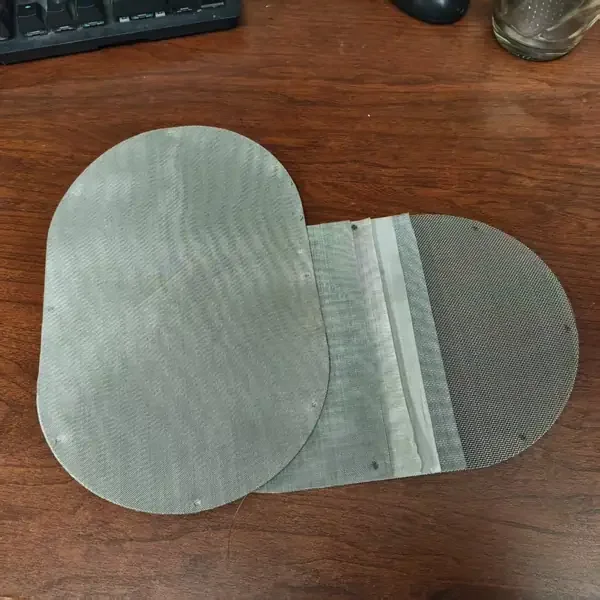
Choosing the right stainless steel wire mesh for filtration requires understanding two key measurements: mesh count and micron rating. At ANPING MAOYE, we manufacture 304 and 316L stainless steel mesh from 20 to 500 mesh count, and engineers ask us daily about converting between these units. This guide provides the complete conversion chart, calculation formulas, and application recommendations based on our 10+ years of production experience.
What Is Mesh Count and Micron Rating?
Mesh count refers to the number of openings per linear inch in a wire mesh. A 100 mesh screen has 100 openings in each direction per inch, creating 10,000 openings per square inch.
Micron rating (or micrometer) measures the actual size of the opening in the mesh. One micron equals 0.001 millimeters. For filtration applications, the micron rating determines what particle size the mesh can filter.
The relationship between mesh count and micron rating is not linear because the wire diameter affects the open area. Thicker wires reduce the aperture size even at the same mesh count.
![IMAGE PLACEHOLDER 1: Diagram showing mesh count vs micron rating visualization - 800x600px, technical diagram showing wire mesh structure]
Complete Mesh Count to Micron Conversion Chart
This table shows standard conversions for 304 stainless steel plain weave wire mesh. Custom specifications are available on request.
| Mesh Count | Wire Diameter (mm) | Aperture (mm) | Micron Rating (μm) | Open Area | Weight (kg/m²) |
|---|---|---|---|---|---|
| 8 | 0.71 | 2.46 | 2460 | 60% | 5.20 |
| 10 | 0.64 | 1.90 | 1900 | 56% | 4.80 |
| 12 | 0.58 | 1.54 | 1540 | 54% | 4.50 |
| 14 | 0.50 | 1.31 | 1310 | 52% | 3.80 |
| 16 | 0.46 | 1.13 | 1130 | 51% | 3.50 |
| 18 | 0.43 | 0.98 | 980 | 49% | 3.20 |
| 20 | 0.40 | 0.87 | 870 | 48% | 3.00 |
| 24 | 0.35 | 0.71 | 710 | 46% | 2.50 |
| 30 | 0.31 | 0.54 | 540 | 42% | 2.20 |
| 40 | 0.25 | 0.39 | 390 | 37% | 1.90 |
| 50 | 0.20 | 0.31 | 310 | 37% | 1.50 |
| 60 | 0.19 | 0.23 | 230 | 30% | 1.50 |
| 70 | 0.16 | 0.20 | 200 | 30% | 1.30 |
| 80 | 0.15 | 0.17 | 170 | 30% | 1.20 |
| 100 | 0.11 | 0.14 | 140 | 31% | 0.90 |
| 120 | 0.09 | 0.12 | 120 | 30% | 0.75 |
| 150 | 0.07 | 0.10 | 100 | 30% | 0.60 |
| 180 | 0.06 | 0.08 | 80 | 28% | 0.50 |
| 200 | 0.055 | 0.072 | 72 | 32% | 0.45 |
| 250 | 0.045 | 0.057 | 57 | 30% | 0.38 |
| 300 | 0.04 | 0.045 | 45 | 28% | 0.35 |
| 325 | 0.035 | 0.043 | 43 | 30% | 0.30 |
| 400 | 0.03 | 0.034 | 34 | 27% | 0.25 |
| 500 | 0.025 | 0.026 | 26 | 25% | 0.20 |
Data for standard 304 stainless steel plain weave mesh. Actual specifications may vary by manufacturer. Contact us for custom specifications.
![IMAGE PLACEHOLDER 2: Photo of 100 mesh stainless steel wire mesh close-up - 800x600px, macro photography showing wire mesh structure]
Mesh Count by Filtration Application
Different industries require different mesh specifications. Based on our experience supplying to 30+ countries, these are the most common mesh counts by application:
Water Filtration
- 40-100 mesh (390-140 μm)
- Removes sediment, sand, and particles from water systems.
Food Processing
- 80-200 mesh (170-72 μm)
- FDA-grade 304 mesh for filtering oils, juices, and dairy.
Chemical Processing
- 100-325 mesh (140-43 μm)
- 316L mesh for corrosive chemical environments.
Air Filtration
- 60-150 mesh (230-100 μm)
- HVAC and industrial air purification systems.
Pharmaceutical
- 200-400 mesh (72-34 μm)
- High-precision filtration for pharmaceutical manufacturing.
Oil & Gas
- 20-80 mesh (870-170 μm)
- Heavy-duty filtration for oil drilling and refining.
Not sure which mesh count you need? Our engineers can recommend the optimal mesh count based on your particle size requirements and operating conditions. We provide free samples for testing.
How to Calculate Aperture Size from Mesh Count
Formula 1: Aperture Size (mm)
Aperture (mm) = (25.4 / Mesh Count) - Wire Diameter (mm)
Example: For 100 mesh with 0.11mm wire diameter: Aperture = (25.4 / 100) - 0.11 = 0.254 - 0.11 = 0.144 mm (144 μm)
Formula 2: Open Area Percentage
Open Area % = (Aperture² / (Aperture + Wire Diameter)²) × 100
Example: For 100 mesh with 0.144mm aperture and 0.11mm wire: Open Area = (0.144² / (0.144 + 0.11)²) × 100 = 31.9%
Formula 3: Micron to Mesh Count (Reverse)
Mesh Count ≈ 25.4 / (Micron / 1000 + Wire Diameter)
Example: If you need 100 micron filtration with 0.07mm wire: Mesh Count ≈ 25.4 / (0.1 + 0.07) = 25.4 / 0.17 ≈ 149 mesh → choose 150 mesh
![IMAGE PLACEHOLDER 3: Diagram showing mesh count calculation formula illustration - 800x600px, technical diagram showing wire diameter, aperture, and mesh count relationship]
Factors That Affect Filtration Performance
1. Material Grade
304 stainless steel handles most industrial applications. 316L adds 2-3% molybdenum for superior corrosion resistance in marine, chemical, and high-salinity environments. For food and pharmaceutical applications, both grades meet FDA requirements when properly processed.
2. Weave Pattern
Plain weave is standard for most applications. Twill weave provides higher strength for heavy-duty filtration. Dutch weave offers finer filtration with thicker support wires. The weave pattern affects both flow rate and filtration precision.
3. Operating Temperature
304 stainless steel withstands up to 800°C (1472°F), while 316L handles up to 870°C (1598°F). For high-temperature applications like polymer filtration or exhaust systems, sintered mesh may be required for structural integrity.
4. Pressure Differential
Higher mesh counts (finer filtration) reduce flow rate. As a general rule, doubling the mesh count reduces flow rate by approximately 40-50%. For high-flow applications, use lower mesh counts or larger filter surface areas to compensate.
5. Particle Size Distribution
The target mesh count should be based on the maximum particle size you need to remove, not the average. If particles range from 50-200 microns, choose a mesh that captures the largest particles (80 mesh / 170 μm) rather than the smallest.
Related Reading
Need help choosing between material grades? Read our detailed comparison:
- 304 vs 316 Stainless Steel Mesh: How to Choose the Right Grade
- Understanding Mesh Count and Micron Rating in Wire Mesh Filtration
Frequently Asked Questions
What is the difference between mesh count and micron rating?
Mesh count measures the number of openings per linear inch, while micron rating measures the actual size of each opening in micrometers. A 100 mesh screen has 100 openings per inch, with each opening approximately 140-150 microns depending on wire diameter.
How do I convert mesh count to microns?
Use the formula: Micron = ((25.4 / Mesh Count) - Wire Diameter) × 1000. For example, 100 mesh with 0.11mm wire has an aperture of (25.4/100 - 0.11) × 1000 = 144 microns. Our conversion chart above provides standard values for common mesh counts.
What mesh count is best for water filtration?
For general water filtration, 40-100 mesh (390-140 microns) is most common. Coarse pre-filtration uses 20-40 mesh, while fine filtration for drinking water may use 100-200 mesh. The choice depends on the contaminant size and flow rate requirements.
Does wire diameter affect the micron rating?
Yes. At the same mesh count, thicker wires create smaller openings. Two manufacturers may both claim “100 mesh” but have different micron ratings if they use different wire diameters. Always verify both mesh count and wire diameter when comparing suppliers.
What is the finest mesh count available?
Standard woven stainless steel mesh is available up to 500 mesh (approximately 26 microns). For finer filtration below 25 microns, consider Dutch weave or sintered mesh technologies, which can achieve sub-micron filtration levels.
Can I get a custom mesh count that is not in the standard chart?
Yes. At ANPING MAOYE, we manufacture custom mesh counts with specific wire diameters to meet your exact filtration requirements. Contact our engineering team with your particle size data and flow rate needs for a custom recommendation.
How does mesh count affect flow rate?
Higher mesh counts (finer filtration) reduce flow rate due to smaller open area. As a general rule, doubling the mesh count reduces flow rate by approximately 40-50%. For high-flow applications, use lower mesh counts or larger filter surface areas to compensate.
What is the difference between US mesh and Tyler mesh?
US mesh and Tyler mesh are two different standards for measuring wire mesh. While they are similar for coarse meshes, they diverge at finer counts. Our conversion chart uses US mesh standard, which is the most common in international trade. If you need Tyler mesh equivalents, please contact us for the cross-reference table.
Conclusion
Understanding the relationship between mesh count and micron rating is essential for selecting the right stainless steel filter mesh. Use the conversion chart above as a quick reference, and apply the calculation formulas when you need custom specifications.
Remember that mesh count alone does not determine filtration performance. Wire diameter, material grade, weave pattern, and operating conditions all play critical roles. When in doubt, request a sample for testing before placing a bulk order.
At ANPING MAOYE, we have manufactured 304 and 316L stainless steel mesh for over 10 years, supplying clients in 30+ countries. We provide free technical consultation and samples to help you select the optimal mesh specification for your application.
Ready to get started? Request a free sample with your specifications, or chat with our engineers on WhatsApp for immediate assistance.